

When growth, change, or pressure comes, many organizations fracture not because of a lack of capability, but because their parts—teams, systems, strategy, culture—aren’t in harmony. Stability, in a dynamic environment, isn’t about rigidity; it’s about resonance—where every component reinforces the others, and the organization moves cohesively as one.
In this article, we’ll explore how to identify your core organizational components, how to align them for synergy, and how to maintain stability—and adaptability—amid complexity.
1. The Myth of Silos: Why Disjointed Components Undermine Stability
Even the best strategies or smartest teams can falter if organizational components pull in different directions. Common disconnects include:
- Strategy vs Execution: Leadership sets vision, but teams struggle to translate it into daily work.
- Structure vs Culture: The org chart may indicate formal authority, but informal norms undermine it.
- Systems vs People: Tools, workflows, or processes get imposed without buy-in or capacity.
- Metrics vs Incentives: KPIs encourage one behavior, but reward systems (bonuses, promotions) encourage another.
These mismatches create tension, ambiguity, and friction. The result: drift, rework, conflict, and eventually, instability.
The goal is to move from a collection of parts toward a living, coherent whole—where each part supports and balances the rest.
2. Core Organizational Components: What Needs Harmony
To pursue harmony, first recognize what components must be aligned. While implementations vary by context, here are the essential pillars:
| Component | Purpose / Role | Typical Misalignment |
|---|---|---|
| Strategy & Vision | Defines direction, priorities, values | Vague or shifting goals; disconnected from daily work |
| Structure & Roles | Organizes teams, clarifies reporting and span | Overlapping authority, ambiguous accountability |
| Processes & Workflows | Sequence of how work flows | Bottlenecks, gaps, inconsistencies, workarounds |
| Systems & Technology | Tools and integrations to support processes | Tool sprawl, silos, slow adoption, poor UX |
| Metrics & Incentives | Measures of success and behavioral drivers | Incentives misaligned with desired behavior |
| Culture & Norms | Shared attitudes, informal rules, trust | Resistance, silos, hidden tensions, blame cycles |
| Capability & Skills | Competencies, training, development | Skill gaps, uneven maturity, outdated practices |
Harmony means these elements reinforce one another. For example:
- Your structure should reflect your strategic priorities and value streams.
- Your metrics should measure what matters and tie directly into incentives and performance management.
- Your culture should encourage the behaviors your strategy needs (e.g. collaboration, experimentation).
- Your systems should support—not dictate—your processes, and be usable enough that people adopt them.
3. Steps to Achieve Harmony
Here’s a practical roadmap for orchestrating alignment across organizational components:
3.1 Diagnose the Current State
- Map each component: document your current strategy, structure, workflows, systems, KPIs, culture, skills.
- Use interviews, surveys, and observation to surface tensions, misalignments, and informal workarounds.
- Identify “hotspots” where misalignment is most damaging (e.g. a process that’s constantly breaking, or a team that feels disconnected).
3.2 Define the Desired State / Target Operating Model
- Articulate the north star: how the components should ideally interlock.
- Draw a model showing how strategy flows into structure, into processes, into systems, into incentives, into culture.
- Specify guiding principles or design rules (e.g. “decisions should be made at the lowest accountable level,” “tools must integrate seamlessly,” “learn fast, fail small”).
3.3 Prioritize & Phase Implementation
You can’t fix everything at once. Pick high-impact alignment areas first (e.g. process + system + metrics in one value stream). Use phases:
- Pilot / pathfinder — test alignment in one domain
- Scale — expand learnings
- Institutionalize — embed in governance
3.4 Enable Buy-in & Change Management
- Involve stakeholders early so changes don’t feel imposed.
- Communicate the “why” of alignment decisions (how this benefits people, teams, customers).
- Offer training, coaching, and transitional support.
- Monitor adoption and respond quickly to resistance or breakdowns.
3.5 Monitor & Adjust (Feedback Loops)
- Build governance: periodic reviews of alignment health (e.g. “harmony metrics”).
- Create forums (retrospectives, cross-team syncs) to surface tension and unmet gaps.
- Run small experiments: test changes, measure impact, iterate.
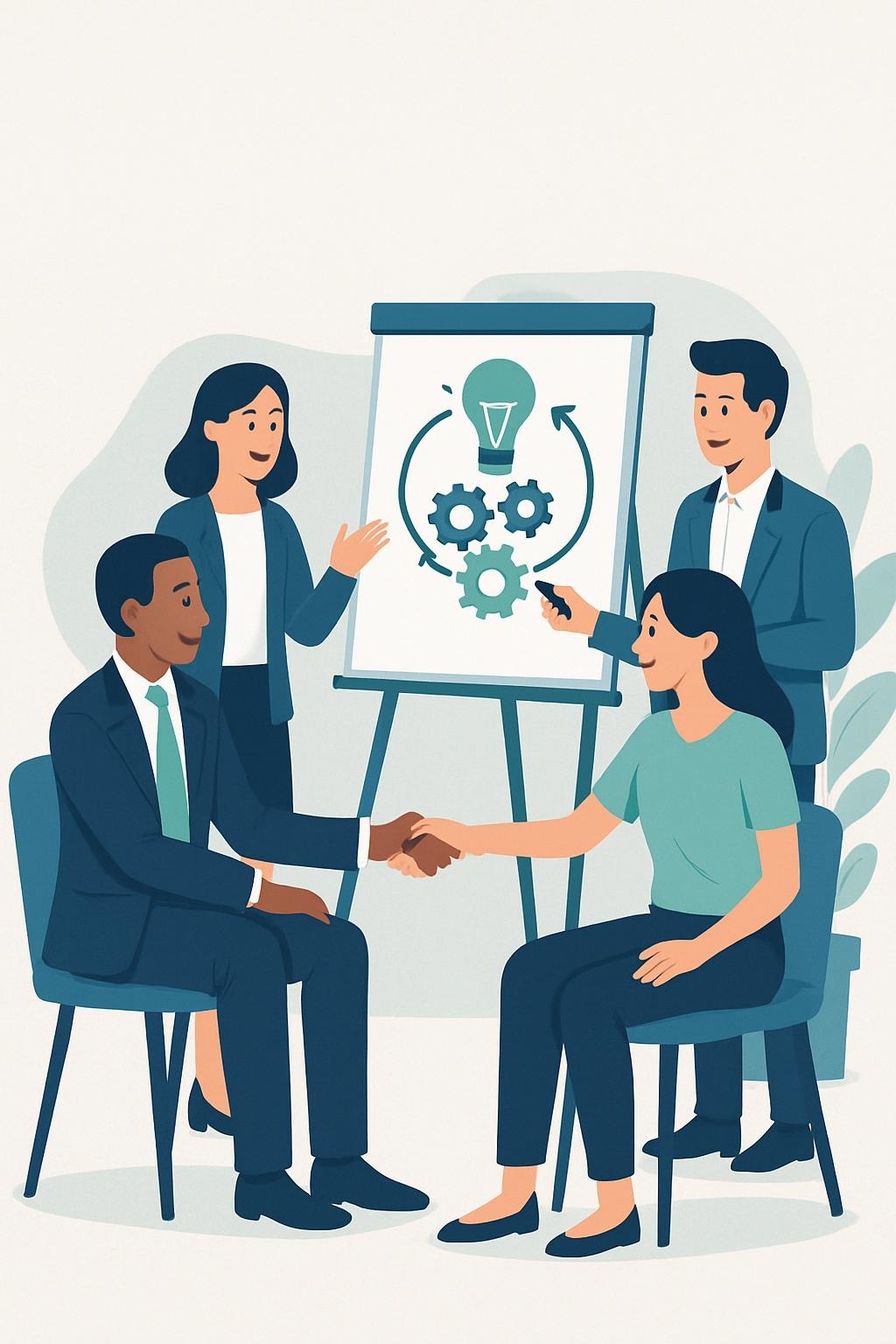

4. Illustrative Example: Harmonizing a Growth Phase
Let’s imagine a mid-sized tech company — “InnoSoft” — is scaling rapidly. Here’s how they might apply harmony thinking:
- Diagnosis
- Strategy: Move from project-led to product portfolio model
- Structure: Teams organized by project, not capability
- Processes: Handoffs are chaotic between dev / QA / ops
- Systems: Disparate tools (Jira, Trello, Slack, custom tools) with low integration
- Metrics: Delivery speed, but no accountability for reliability
- Culture: Siloed teams, “not my job” attitudes
- Capabilities: Some teams lack DevOps and automation experience
- Desired State
- Strategy calls for modular products and shared services
- Structure organized by product verticals + platform teams
- Processes standard pipelines with CI/CD, staging, rollback
- Systems consolidated into integrated toolchain
- Metrics include uptime, deploy frequency, customer feedback
- Culture emphasizes shared responsibility, learning, and cross-team collaboration
- Capabilities built via training in DevOps, automated testing, system design
- Pilot & Phase
- Start with one product team: align structure, tools, process, metrics
- Learn and refine before expanding to others
- Change & Adoption
- Run workshop to explain new model
- Assign “alignment champions” in each team
- Monitor adoption and intervene on slack or conflict
- Feedback & Course Correction
- Monthly “harmony check” with leadership
- Teams surface small misalignments (e.g. tool gaps, incentive mismatches)
- Adjust light-weightly before problems escalate
Over time, what once felt like disjointed parts begins to function like a well-tuned system: shifts in strategy ripple predictably and smoothly through operations, teams collaborate more fluidly, and stability coexists with adaptability.
5. Common Risks & Mitigation
| Risk | Sign | Mitigation |
|---|---|---|
| Overcentralization | Sluggish decisions, lack of autonomy | Preserve local decision rights where appropriate |
| Underestimating culture | Tools or structure change, but behavior doesn’t | Invest in culture, role modeling, reinforcement |
| Too broad scope | Diluted efforts, lack of focus | Phase work, focus on high-leverage components first |
| Ignoring feedback | Misalignments persist, resistance grows | Build tight feedback loops, listen and adjust |
| Tool fixation | Investing in systems before processes or people | Start with process clarity and people alignment before tooling |
6. Key Takeaways & Next Steps
Stability through alignment, not rigid control.
Harmony, not perfection: The goal is not perfect alignment but ongoing balance.
Interdependency matters: Strategy, structure, process, systems, culture—they all influence one another.
Start small & scale: Pilot alignment in one domain, learn, then extend.
Feedback is your compass: Use it to detect friction early.